247verdict.com earns affiliate commissions on purchases — at no extra cost to you.
🏃

Best Sports & Outdoor Gear

Sports and outdoor gear spans an enormous price range with equally enormous variation in quality. We cut through the marketing — GPS accuracy, battery life under real conditions, durability in actual outdoor use — to tell you what's worth the investment.

Our Top Picks

Updated 2026-05.

Editor's Pick

Garmin Forerunner 265 GPS Running Watch

AMOLED display, dual-band GPS, 13-day battery, HRV status. The serious runner's smart watch.

★★★★☆ 4.5 (8,400 Amazon reviews)
AMOLED display is the clearest running watch screen available at this price
Dual-band GPS (L1+L5) delivers within 1% distance accuracy on technical routes
13-day battery in smartwatch mode, 20 hours GPS — enough for ultra-marathon training
Price range: Mid-Range
Best Value

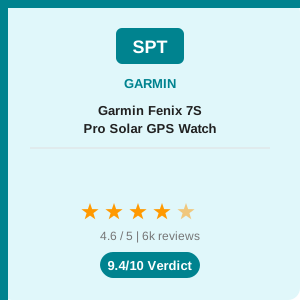
Garmin Fenix 7S Pro Solar GPS Watch

Solar charging, full topo maps, 37-day battery, titanium bezel. The expedition multisport standard.

★★★★☆ 4.6 (5,600 Amazon reviews)
Solar charging extends battery to theoretically unlimited in constant sunlight (37+ days in smartwatch mode)
Full topo maps with turn-by-turn navigation — no phone needed in the backcountry
Running Dynamics Pod support tracks ground contact time, stride length and vertical oscillation
Price range: Premium
Also Recommended

Fitbit Charge 6 Fitness Tracker

Built-in GPS, 7-day battery, EDA stress sensor, ECG. The most complete slim fitness tracker.

★★★★☆ 4.3 (16,200 Amazon reviews)
Built-in GPS for route tracking without a phone — unique at this form factor
Electrodermal Activity sensor measures stress response — a rare and genuinely useful feature
ECG app screens for atrial fibrillation — meaningful cardiac health monitoring
Price range: Mid-Range

Affiliate links — we may earn a commission at no extra cost to you.

All Sports & Outdoors Products Reviewed

Filter by price:
ProductBrandScorePrice RangeAmazon RatingBuy
Garmin Forerunner 265 GPS Running Watch Pick Garmin 9.2/10 Mid-Range 4.5★ (8,400) 🛒 Amazon
Garmin Fenix 7S Pro Solar GPS Watch Pick Garmin 9.4/10 Premium 4.6★ (5,600) 🛒 Amazon
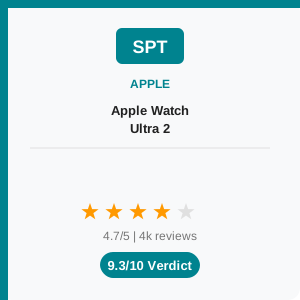
Apple Watch Ultra 2 Apple 9.1/10 Premium 4.6★ (9,800) 🛒 Amazon
Fitbit Charge 6 Fitness Tracker Pick Fitbit 8.7/10 Mid-Range 4.3★ (16,200) 🛒 Amazon
WHOOP 4.0 Fitness Tracker WHOOP 8.5/10 Mid-Range 4.2★ (12,400) 🛒 Amazon
Osprey Talon 22 Hiking Backpack Pick Osprey 9.1/10 Mid-Range 4.7★ (18,600) 🛒 Amazon
Hydro Flask 32oz Wide Mouth Water Bottle Pick Hydro Flask 9.3/10 Mid-Range 4.8★ (68,000) 🛒 Amazon
GoPro HERO12 Black Action Camera Pick GoPro 9.0/10 Mid-Range 4.4★ (11,200) 🛒 Amazon
Fit Simplify Resistance Band Set Pick Fit Simplify 8.9/10 Budget 4.6★ (82,000) 🛒 Amazon
Liforme Original Yoga Mat Pick Liforme 9.1/10 Mid-Range 4.6★ (7,800) 🛒 Amazon
Garmin Forerunner 165 GPS Running Watch Garmin 8.9/10 Mid-Range 4.5★ (6,100) 🛒 Amazon
Nalgene 32oz Wide Mouth Water Bottle Nalgene 9.0/10 Budget 4.8★ (44,000) 🛒 Amazon

What to Look For

GPS Accuracy

GPS accuracy varies significantly between watches. Garmin and Apple Watch Ultra lead the field. Budget devices often have 5-15% distance error that compounds on longer runs. If pace accuracy matters for training, it's worth paying for dual-band GPS (L1+L5).

Battery Life vs Feature Use

Manufacturer battery figures are measured with GPS off or minimal feature use. A watch claiming '7 days' typically gets 3-4 days with always-on display and heart rate tracking. GPS-on battery is the figure that matters for outdoor use.

Water Resistance Rating

5ATM (50m) is the minimum for swimming. 10ATM (100m) for serious water sports. WR50 or WR100 ratings are typical for sports watches. IP68 (dust/water) is not the same as ATM — IP68 doesn't guarantee swimming safety.

Health Tracking Accuracy

Heart rate, SpO2 and sleep tracking accuracy varies enormously. Chest strap HR monitors remain more accurate than wrist-based for intense exercise. Wrist HR is adequate for zones 1-3; unreliable for sprint intervals.

Ecosystem & App Integration

Consider where your data lives. Garmin Connect, Apple Health, Google Fit and Strava all work differently. Cross-device switching is difficult if you're locked into a proprietary ecosystem. Garmin integrates with Strava; Apple Watch requires iPhone.

Build Quality & Durability

Outdoor gear takes real abuse. Check MIL-STD-810 ratings for watches, seam-sealing on backpacks, and Gore-Tex vs proprietary waterproofing on clothing. Gore-Tex has 30 years of field-proven durability data; proprietary coatings often degrade within 2-3 years.

Common Buying Mistakes

  • Buying a watch with impressive features without checking battery life for YOUR specific use — a GPS watch that dies at mile 18 of a marathon is useless
  • Confusing IP68 water resistance with swimming capability — IP ratings aren't tested under pressure like ATM ratings
  • Assuming Apple Watch GPS accuracy matches Garmin — it doesn't for serious distance runners
  • Buying a hydration pack with a chest fit rather than trying it on — fit variance between brands is enormous
  • Ignoring the ecosystem lock-in — your 5 years of Garmin health data doesn't transfer to Apple Watch

Frequently Asked Questions

Garmin vs Apple Watch for running — which is better?

Garmin wins for serious runners: superior GPS accuracy (especially dual-band L5), longer battery life, better training analytics and no iPhone dependency. Apple Watch Ultra is competitive at its price point and integrates better with iPhone, but the ecosystem lock-in and daily charging requirement make it less practical for longer outdoor activities.

Is a £500 running watch worth it over a £200 one?

Depends entirely on what you do. For 5K-half marathon runners who want accurate pace data: the £200 tier (Garmin Forerunner 265) is genuinely excellent. For marathon runners, trail runners and multisport athletes who need expedition battery life, full topo maps or ANT+ sensor integration, the premium tier justifies itself.

What's the best sports watch for beginners?

The Garmin Forerunner 165 (£200) for runners, or the Apple Watch Series 9 for iPhone users who want an all-rounder. Both provide accurate GPS, heart rate monitoring and structured workout guidance without overwhelming complexity.

Do fitness trackers actually improve fitness?

Research suggests yes — but primarily through habit formation and goal-setting, not because the hardware does anything special. The insight into sleep quality, HRV and recovery metrics genuinely helps athletes avoid overtraining. Whether a £30 tracker or a £600 watch delivers this depends on how seriously you engage with the data.