247verdict.com earns affiliate commissions on purchases — at no extra cost to you.

Best Sports & Outdoors for Everyday Health (2026)

Finding the right sports & outdoors for everyday health — we researched 2 options and selected the best.

📅 Updated 2026-05 🔍 2 products reviewed 🇬🇧🇺🇸 UK & US links

Best for Everyday Health

Editor's Pick

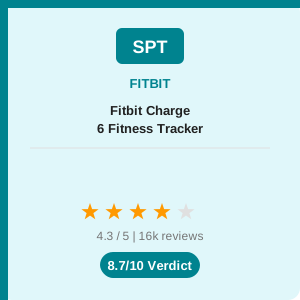
Fitbit Charge 6 Fitness Tracker

Built-in GPS, 7-day battery, EDA stress sensor, ECG. The most complete slim fitness tracker.
★★★★☆ 4.3 (16,200 Amazon reviews)
Built-in GPS for route tracking without a phone — unique at this form factor
Electrodermal Activity sensor measures stress response — a rare and genuinely useful feature
ECG app screens for atrial fibrillation — meaningful cardiac health monitoring
Price range: Mid-Range
Best Value

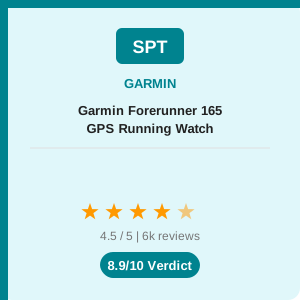
Garmin Forerunner 165 GPS Running Watch

Entry AMOLED Garmin with training readiness and 11-day battery. The beginner's serious GPS watch.

★★★★☆ 4.5 (6,100 Amazon reviews)
AMOLED display brings Garmin's best screen to the entry price point
Training Readiness score guides workout intensity without overwhelming beginners
11-day battery in smartwatch mode — matches the more expensive Forerunner 265
Price range: Mid-Range

Affiliate links — we earn a small commission at no extra cost to you. Learn more.

Why These Made Our List

#1: Fitbit Charge 6 Fitness Tracker

Best for: Those wanting everyday health tracking with genuine stress and cardiac monitoring in a slim wristband form factor.

The Charge 6 packs genuinely advanced health monitoring — EDA stress, ECG, built-in GPS — into a slim band. The subscription dependency is a real consideration, but the hardware itself represents the best health-focused tracker available in this form factor.

Full verdict →

#2: Garmin Forerunner 165 GPS Running Watch

Best for: Beginner to intermediate runners who want a proper Garmin GPS watch with AMOLED display and training guidance under £200.

The Forerunner 165 is where beginners should start with Garmin. AMOLED display, Training Readiness and 11-day battery at under £200 brings the core Garmin experience to a more accessible price. The single-band GPS and missing HRV are the only meaningful downgrades vs the 265.

Full verdict →

How to Choose: Sports & Outdoors for Everyday Health

Sports and outdoor gear spans an enormous price range with equally enormous variation in quality. We cut through the marketing — GPS accuracy, battery life under real conditions, durability in actual outdoor use — to tell you what's worth the investment.

What to Look For

These are the factors that genuinely separate good purchases from regretted ones:

GPS Accuracy

GPS accuracy varies significantly between watches. Garmin and Apple Watch Ultra lead the field. Budget devices often have 5-15% distance error that compounds on longer runs. If pace accuracy matters for training, it's worth paying for dual-band GPS (L1+L5).

Battery Life vs Feature Use

Manufacturer battery figures are measured with GPS off or minimal feature use. A watch claiming '7 days' typically gets 3-4 days with always-on display and heart rate tracking. GPS-on battery is the figure that matters for outdoor use.

Water Resistance Rating

5ATM (50m) is the minimum for swimming. 10ATM (100m) for serious water sports. WR50 or WR100 ratings are typical for sports watches. IP68 (dust/water) is not the same as ATM — IP68 doesn't guarantee swimming safety.

Health Tracking Accuracy

Heart rate, SpO2 and sleep tracking accuracy varies enormously. Chest strap HR monitors remain more accurate than wrist-based for intense exercise. Wrist HR is adequate for zones 1-3; unreliable for sprint intervals.

Ecosystem & App Integration

Consider where your data lives. Garmin Connect, Apple Health, Google Fit and Strava all work differently. Cross-device switching is difficult if you're locked into a proprietary ecosystem. Garmin integrates with Strava; Apple Watch requires iPhone.

Build Quality & Durability

Outdoor gear takes real abuse. Check MIL-STD-810 ratings for watches, seam-sealing on backpacks, and Gore-Tex vs proprietary waterproofing on clothing. Gore-Tex has 30 years of field-proven durability data; proprietary coatings often degrade within 2-3 years.

Mistakes to Avoid

  • Buying a watch with impressive features without checking battery life for YOUR specific use — a GPS watch that dies at mile 18 of a marathon is useless
  • Confusing IP68 water resistance with swimming capability — IP ratings aren't tested under pressure like ATM ratings
  • Assuming Apple Watch GPS accuracy matches Garmin — it doesn't for serious distance runners
  • Buying a hydration pack with a chest fit rather than trying it on — fit variance between brands is enormous
  • Ignoring the ecosystem lock-in — your 5 years of Garmin health data doesn't transfer to Apple Watch

Understanding the Price Ranges

Under 200: Budget tier. Basic GPS watches, entry running gear. Adequate for casual fitness tracking.

200–500: Mid-range sweet spot. Garmin Forerunner 265, Polar Pacer Pro. Proper training tools.

500–1000: Premium tier. Garmin Fenix 7, Apple Watch Ultra. Expedition-grade tracking and durability.

1000+: Luxury tier. Top multisport computers, expedition watches with satellite messaging.

Price Ranges Explained

under-200

Budget tier. Basic GPS watches, entry running gear. Adequate for casual fitness tracking.

200-500

Mid-range sweet spot. Garmin Forerunner 265, Polar Pacer Pro. Proper training tools.

500-1000

Premium tier. Garmin Fenix 7, Apple Watch Ultra. Expedition-grade tracking and durability.

1000-plus

Luxury tier. Top multisport computers, expedition watches with satellite messaging.

Frequently Asked Questions

Garmin vs Apple Watch for running — which is better?

Garmin wins for serious runners: superior GPS accuracy (especially dual-band L5), longer battery life, better training analytics and no iPhone dependency. Apple Watch Ultra is competitive at its price point and integrates better with iPhone, but the ecosystem lock-in and daily charging requirement make it less practical for longer outdoor activities.

Is a £500 running watch worth it over a £200 one?

Depends entirely on what you do. For 5K-half marathon runners who want accurate pace data: the £200 tier (Garmin Forerunner 265) is genuinely excellent. For marathon runners, trail runners and multisport athletes who need expedition battery life, full topo maps or ANT+ sensor integration, the premium tier justifies itself.

What's the best sports watch for beginners?

The Garmin Forerunner 165 (£200) for runners, or the Apple Watch Series 9 for iPhone users who want an all-rounder. Both provide accurate GPS, heart rate monitoring and structured workout guidance without overwhelming complexity.