247verdict.com earns affiliate commissions on purchases — at no extra cost to you.

Best Pet & Animal Care for Scheduled Feeding (2026)

Finding the right pet & animal care for scheduled feeding — we researched 2 options and selected the best.

📅 Updated 2026-05 🔍 2 products reviewed 🇬🇧🇺🇸 UK & US links

Best for Scheduled Feeding

Editor's Pick

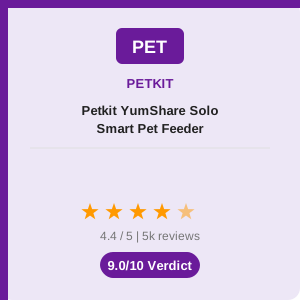
Petkit YumShare Solo Smart Pet Feeder

Camera-equipped feeder, portion accuracy ±1g, dual food chambers, scheduling app.
★★★★☆ 4.4 (5,200 Amazon reviews)
Built-in 1080p camera captures a photo every time your pet eats — tracks feeding behaviour
±1g portion accuracy is best-in-class — critical for cats on prescribed diets
Dual food chambers allow automatic mixing of wet and dry food
Price range: Premium
Best Value

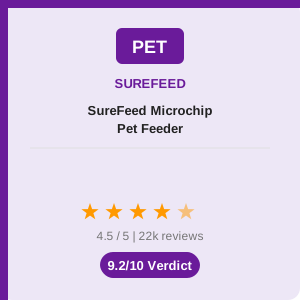
SureFeed Microchip Pet Feeder

Opens only for your specific pet's microchip or collar tag. Essential for multi-pet households.

★★★★☆ 4.5 (22,400 Amazon reviews)
Opens exclusively for the registered pet's microchip — prevents food stealing in multi-pet homes
Works with existing microchip (no additional tags) or supplied RFID collar tag
Sealed bowl and lid prevent food drying out — keeps wet food fresh for hours
Price range: Mid-Range

Affiliate links — we earn a small commission at no extra cost to you. Learn more.

Why These Made Our List

#1: Petkit YumShare Solo Smart Pet Feeder

Best for: Multi-pet households or cats on prescription diets who need precise portion control and feeding monitoring.

The Petkit YumShare Solo earns its place at the premium tier through per-feeding camera shots and ±1g accuracy. For pets on prescription diets or weight management, the accuracy is meaningful. The integrated camera closes the loop — you see what was dispensed and whether it was eaten.

Full verdict →

#2: SureFeed Microchip Pet Feeder

Best for: Multi-pet households where pets steal each other's food, or where one pet is on a prescription diet that others shouldn't access.

The SureFeed Microchip Feeder solves a specific problem perfectly: ensuring only the right pet can access their food. 22,400 reviews at 4.5★ is exceptional for a specialist product — it works reliably over years of daily use. For multi-pet households with prescription diets, it's essential.

Full verdict →

How to Choose: Pet & Animal Care for Scheduled Feeding

The pet tech market has matured significantly — pet cameras that dispense treats remotely, GPS trackers accurate to 2.5 metres, and smart feeders that send photos when your pet eats. We review the genuinely useful products and cut through the gimmicks.

What to Look For

These are the factors that genuinely separate good purchases from regretted ones:

GPS Tracker Accuracy & Coverage

Pet GPS trackers use cellular networks, not GPS alone. Coverage depends on your mobile network's reach. In cities, accuracy is typically 2-5 metres. In rural areas, coverage can drop. Check which network the tracker uses and verify coverage in your specific area before buying.

Pet Camera: Video Quality vs Features

1080p is sufficient for pet cameras — 4K adds file size without useful benefit for monitoring. Prioritise: night vision quality (pets move at night), treat tossing accuracy, two-way audio clarity, and app reliability. A 1080p camera with excellent night vision beats a 4K camera that's grainy in low light.

Smart Feeder: Portion Control

Portion control accuracy varies enormously between feeders. The best models deliver within 1-3g of the set amount consistently. Cheaper models can vary by 10-15g — significant for cats on prescription diets or weight management.

Grooming Tools: Coat Type

Grooming tools are highly coat-specific. FURminator deshedding tools are highly effective for double-coated breeds but can damage single-coat breeds. Slicker brushes suit most coat types. For matted fur, dematting combs prevent the stress of scissor cutting.

Subscription Costs

Pet GPS trackers almost always require a monthly subscription (£5-15/month). Factor this into the total cost of ownership. A £40 tracker with a £10/month subscription costs more over 2 years than a £100 tracker with a £5/month plan.

Mistakes to Avoid

  • Buying a pet GPS tracker without checking network coverage in your specific area
  • Choosing a pet camera based on video resolution alone — night vision quality matters more for most owners
  • Buying a FURminator for a single-coat dog breed — it can damage the coat
  • Ignoring the subscription cost of GPS trackers — factor in 2-year total cost
  • Automatic feeders with gravity dispensing rather than portion control — gravity feeders don't regulate intake

Understanding the Price Ranges

Under 50: Budget pet accessories. Manual feeders, basic cameras, entry grooming tools.

50–150: Mid-range. Furbo cameras, entry GPS trackers, quality grooming sets.

150–300: Premium. Tractive GPS, Petkit smart systems, automatic litter boxes.

300+: Luxury. Multi-pet systems, professional grooming equipment.

Price Ranges Explained

under-50

Budget pet accessories. Manual feeders, basic cameras, entry grooming tools.

50-150

Mid-range. Furbo cameras, entry GPS trackers, quality grooming sets.

150-300

Premium. Tractive GPS, Petkit smart systems, automatic litter boxes.

300-plus

Luxury. Multi-pet systems, professional grooming equipment.

Frequently Asked Questions

What's the best pet GPS tracker for dogs?

The Tractive GPS DOG 4 LTE is the most popular with the best app and network coverage across UK and EU. Apple AirTag works as a passive lost-tag rather than real-time tracker — it requires someone with an iPhone nearby to ping the location, making it less reliable for active tracking. For real-time tracking, Tractive is the standard recommendation.

Are pet cameras worth it?

For dogs with separation anxiety, or those who frequently travel without pets, yes. The ability to speak to your pet, monitor their behaviour and — with treat-dispensing models — reward them remotely is genuinely useful. For cats, the value is lower as cats are more independent.

How often should I groom my dog?

Frequency depends on coat type. Long-coated breeds like Golden Retrievers and Border Collies need grooming 2-3 times per week to prevent matting. Short-coated breeds like Beagles need only weekly brushing. Double-coated breeds shed seasonally and benefit from deshedding tools during moulting periods.