247verdict.com earns affiliate commissions on purchases — at no extra cost to you.

Best Home Fitness for Travel Fitness (2026)

Finding the right home fitness for travel fitness — we researched 2 options and selected the best.

📅 Updated 2026-05 🔍 2 products reviewed 🇬🇧🇺🇸 UK & US links

Best for Travel Fitness

Editor's Pick

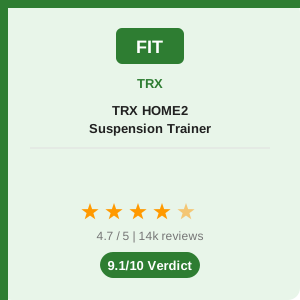
TRX HOME2 Suspension Trainer

Full-body workout from a door frame. 300+ exercises. The most space-efficient home gym equipment.
★★★★☆ 4.7 (14,200 Amazon reviews)
300+ exercises from a single attachment point — door, beam, or outdoor anchor
Weighs 450g — the most portable serious training system
Scales from beginner to elite by adjusting body angle
Price range: Mid-Range
Best Value

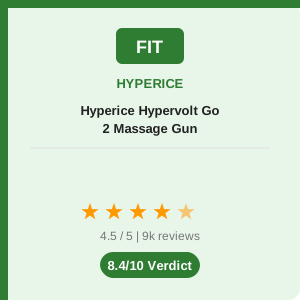
Hyperice Hypervolt Go 2 Massage Gun

Portable percussion recovery at a fair price. Quiet, effective, and small enough to live in a gym bag.

★★★★☆ 4.5 (8,700 Amazon reviews)
Compact and lightweight at 680g — genuinely portable
Quiet enough to use in an office or shared space
3 speed settings cover warm-up, recovery and deep tissue
Price range: Mid-Range

Affiliate links — we earn a small commission at no extra cost to you. Learn more.

Why These Made Our List

#1: TRX HOME2 Suspension Trainer

Best for: Those wanting a full-body workout with minimal equipment and space — ideal for travel, small flats, or outdoor training.

The TRX is the most space-efficient serious training system available. 450 grams and a door frame replaces thousands of pounds of gym equipment for 80% of what most people actually need. The angle-based resistance scaling means it genuinely grows with you.

Full verdict →

#2: Hyperice Hypervolt Go 2 Massage Gun

Best for: Regular gym-goers wanting effective portable recovery without professional-grade complexity or cost.

The Hypervolt Go 2 is the recovery tool for gym-goers who want effective percussion without the Theragun price. Compact, quiet and long-lasting — it lives in a gym bag without complaint. The 10mm amplitude handles everyday recovery well. For deeper work, step up to the Pro.

Full verdict →

How to Choose: Home Fitness for Travel Fitness

Home gym equipment is a significant purchase — and the market is full of brands that look impressive in photos but fall apart within a year. Our verdict is based on build quality, long-term reliability data, and whether the equipment will actually get used.

What to Look For

These are the factors that genuinely separate good purchases from regretted ones:

Weight Capacity & Frame Quality

Never buy a treadmill or bike without checking the weight limit and frame warranty. Steel frames with powder coating outlast aluminium.

Motor Quality (treadmills)

Continuous duty horsepower (CHP) is the figure that matters, not peak HP. For running: 2.5 CHP minimum. Under-powered motors burn out within 18 months of regular use.

Noise Level

Critical if you live in a flat or have family members asleep. Belt-drive bikes and magnetic resistance treadmills are quietest. Anything under 60dB is genuinely quiet.

Footprint & Foldability

Measure your space including the safety zone (1.5m behind treadmill belts). Folding treadmills save space but add weight and complexity.

Console & Connectivity

Bluetooth heart rate, Strava/Zwift compatibility, and incline controls add genuine motivation value. Proprietary app lock-in is a long-term cost consideration.

Warranty Terms

Frame/motor/parts/labour warranties are all separate. A 'lifetime frame warranty' with 90-day labour is essentially worthless. Look for balanced coverage across all four.

Mistakes to Avoid

  • Buying a folding treadmill to save space — they're heavier and harder to fold than the photos suggest
  • Ignoring the weight limit on a bike or treadmill as 'only a guideline'
  • Buying smart fitness equipment without checking the ongoing app subscription cost
  • Underestimating the noise impact on neighbours — especially for running at 6am

Understanding the Price Ranges

Under 200: Entry-level equipment. Fine for walking or light use. Not suitable for daily running.

200–500: Mid-range. Suitable for regular moderate use. Good 2–3 year lifespan with proper use.

500–1000: Semi-professional. Daily use viable. Expect 5+ year lifespan.

1000+: Professional grade. Commercial-quality build. 10+ year lifespan for serious athletes.

Price Ranges Explained

under-200

Entry-level equipment. Fine for walking or light use. Not suitable for daily running.

200-500

Mid-range. Suitable for regular moderate use. Good 2–3 year lifespan with proper use.

500-1000

Semi-professional. Daily use viable. Expect 5+ year lifespan.

1000-plus

Professional grade. Commercial-quality build. 10+ year lifespan for serious athletes.

Frequently Asked Questions

Is a home gym actually cheaper than a gym membership?

Over 3 years, usually yes. A £1,000 treadmill vs £50/month gym membership breaks even at 20 months. The caveat: home equipment only saves money if you actually use it.

What's the best home gym equipment for small spaces?

Adjustable dumbbells, a folding resistance bench, and a pull-up bar. These cover 80% of strength training in a 2x2 metre footprint. For cardio: a stationary bike is narrower than a treadmill.

Are cheap treadmills worth buying?

For walking (up to 6km/h), a £200–300 treadmill is fine. For running, no — underpowered motors overheat and the frame vibrates at speed. Spend at least £500 for a treadmill you intend to run on regularly.